
Key Takeaways
- Skytree commercial Stratus system will capture 7,200 tonnes of atmospheric CO₂ per year to supply 10 greenhouses across 80 hectares in the Netherlands.
- The Stratus system uses proprietary moving-bed technology that reduces electricity consumption to as low as 0.9 MWh per tonne of CO₂ by integrating low-grade heat.
- Lingezegen Energy's renewable infrastructure — including a floating solar park and thermal storage — will host the deployment, decoupling CO₂ supply from fossil fuel combustion.
- The system maintains output within a ±5% seasonal variance across temperatures ranging from -35°C to 50°C, supported by AI-powered process control software.
- The partnership marks Skytree's transition from R&D and field trials to commercial manufacturing at scale.
A New CO₂ Supply Model for Dutch Horticulture
Skytree, a developer of modular onsite Direct Air Capture (DAC) technology, and Lingezegen Energy, a Dutch energy company serving the horticultural sector, have announced a partnership to provide fossil-free CO₂ to a greenhouse cluster in the Netherlands. The collaboration aims to replace increasingly scarce and costly industrial CO₂ sources with atmospheric capture at the point of use, offering growers a decentralized and sustainable supply chain.
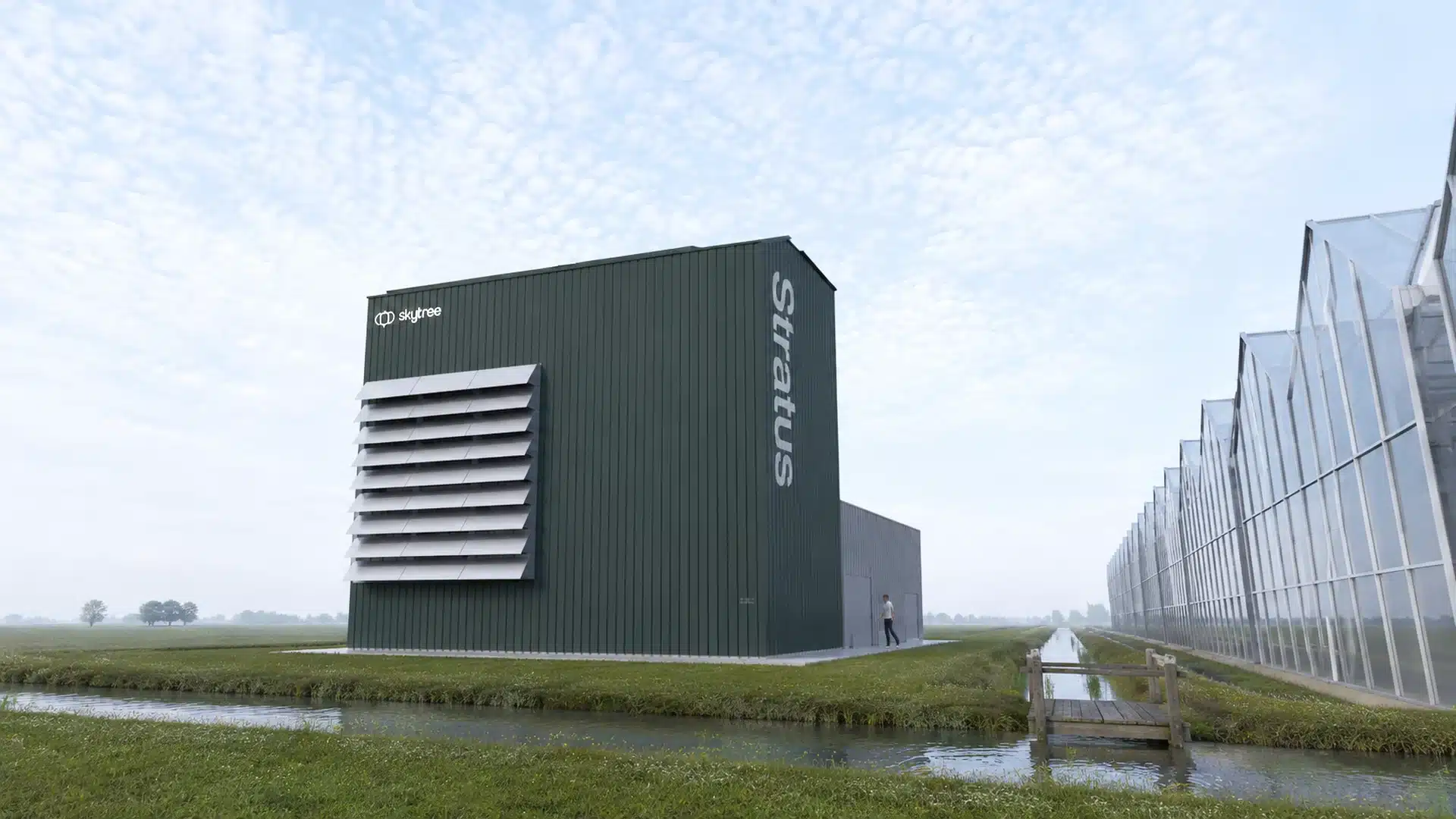
The Skytree Stratus system planned for deployment at Lingezegen Energy is designed to capture 7,200 tonnes of CO₂ from ambient air each year. That supply will serve 10 greenhouses spanning 80 hectares, integrated directly into Lingezegen Energy's existing renewable infrastructure, which includes a floating solar park and thermal energy storage. CO₂ enrichment is an essential input for maximizing crop yields and quality in controlled environment agriculture, making a reliable and affordable supply critical for growers.
“Our partnership with Lingezegen Energy is a pivotal moment for the Dutch horticultural sector as it proves that circular, atmospheric CO₂ is no longer a concept for the future, but a financially viable, scalable solution available today to protect the long-term competitiveness of Dutch greenhouses. By decoupling CO₂ supply from fossil fuel combustion, we help solve the CO₂ crisis for the Dutch greenhouse sector and help growers reduce their carbon footprint,” said Rob van Straten, CEO of Skytree.
Skytree Stratus: Technical Design and Performance
The Stratus system is built around a proprietary moving-bed architecture that separates the adsorption and desorption stages of the capture process. By moving the sorbent material between a cold chamber and a hot chamber, the system heats only the material capturing CO₂ — rather than the entire machine — significantly reducing energy demand. The design allows Skytree to integrate low-grade heat (≥80°C) for 80% of the heating load, bringing electricity consumption down to as low as 0.9 MWh per tonne of CO₂.
Proprietary AI-powered process control software monitors ambient conditions in real time, enabling the system to maintain consistent output within a ±5% seasonal variance across an operating temperature range of -35°C to 50°C. This level of reliability is central to Skytree's commercial proposition for customers who require a dependable CO₂ supply regardless of season or climate.
“We solved the fundamental energy penalty of Direct Air Capture by rethinking the architecture. By moving the sorbent between cold and hot chambers, we ensure we are only heating the material that captures the CO₂, not the steel machine itself. This allows us to utilize low-grade heat and reduce electricity consumption to as low as 0.9 MWh per tonne: a figure that finally makes onsite CO₂ capture financially viable for many customers,” said Wojciech Glazek, CTO at Skytree.
Modular Architecture and Scalability
The Stratus system follows a modular design, with single-unit capture capacity starting at 2.5 tonnes of CO₂ per day and the ability to be configured into larger parks of any size. Serial manufacturing of standardized modules is intended to drive down hardware costs through economies of scale. The modular approach also means maintenance can be conducted on individual units without shutting down the entire system, and field upgrades allow for the integration of improved sorbents over time as the technology advances.
Skytree positions the Stratus as a solution for operators facing high liquid CO₂ prices, frequent supply shortages, or regulatory pressure to decarbonize — including Dutch greenhouse operators, e-fuel producers, and food and beverage companies that rely on CO₂ for carbonation and packaging.
From R&D to Commercial Manufacturing
The Lingezegen Energy deployment represents a commercial milestone for Skytree, which validated the Stratus system's performance over more than two years of operational lab data. The company describes the project as marking its shift from an organization focused on research and field trials to a commercial manufacturer delivering systems at industrial scale.
“The future of Dutch greenhouse horticulture does not lie in clinging to fossil fuels, but in embracing innovation. Capturing CO₂ from ambient air is not a luxury, it is the key to a sustainable and thriving sector,” said Berno Schouten, CEO of Lingezegen Energy.
The partnership reflects a broader shift in the sustainability strategies of Dutch greenhouse operators, who face both the phase-out of traditional industrial CO₂ sources and mounting pressure to reduce their carbon footprint across the supply chain.

