
Key Takeaways:
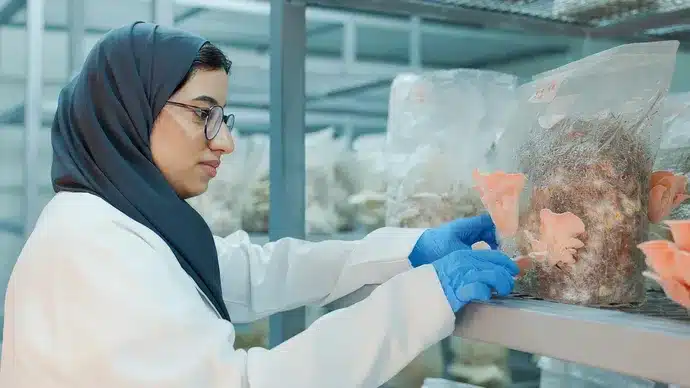
- The UAE University (UAEU) has launched the Smart Mushroom House at Al Foah Research Farm in Al Ain, an IoT-powered facility focused on sustainable mushroom cultivation and agricultural waste recycling.
- The facility can accommodate up to 600 mushroom cultivation bags per cycle, holding nearly three tonnes of substrate, with a production yield of 20–30% depending on the species.
- The initiative forms part of the ASPIRE Research Institute for Food Security in Drylands (ARIFSID) project and is aligned with the UAE's National Food Security Strategy 2051.
- Research currently covers oyster mushrooms, lion's mane, Ganoderma, chicken-of-the-woods, turkey tail, and king oyster mushrooms, alongside ongoing work on domesticating local desert truffles under controlled conditions.
- Three UAE national undergraduate students are actively involved in research, with one student, Ghalia Abdulla AlKhateri, securing second place at the Emirates Agriculture Conference and Exhibition in May 2025.
An IoT-Powered Facility Turns Agricultural Waste Into Food
The UAE University has opened the Smart Mushroom House, a research facility at Al Foah Research Farm in the Al Ain Region that uses Internet of Things technologies to cultivate mushrooms from recycled date palm and other biological waste. The facility was developed by researchers from the Department of Integrative Agriculture at the College of Agriculture and Veterinary Medicine, in international collaboration with the Omex Laboratory at the University of Malaya.
The project sits within the broader ARIFSID initiative titled Date Palm Waste Management and Mushroom Production for Food Security, headed by Dr. Shyam Kurup, and is designed to contribute to sustainable food production in arid and dryland environments.
How the UAE University Facility Works
Smart Infrastructure and Climate Control
The Smart Mushroom House is equipped with IoT-enabled systems that allow precise control of temperature, humidity, lighting, and ventilation. The facility includes three independent smart cultivation tents and a central incubator for climate simulation, enabling the simultaneous cultivation of multiple mushroom species under optimised conditions.
Production Capacity
Each cultivation cycle can accommodate up to 600 mushroom bags holding nearly three tonnes of substrate. Production yields range from 20 to 30 percent against the substrate weight, depending on the species being cultivated.
Species Under Cultivation
Current research focuses on oyster mushrooms, lion's mane, Ganoderma, chicken-of-the-woods, turkey tail, and king oyster mushrooms. The facility is also conducting ongoing work on domesticating local desert truffles — known locally as Faqa and Zubaidi — under controlled conditions. Additional research explores value-added applications including mycelium-based functional foods, edible films, and the conversion of Spent Mushroom Waste into nano-biochar.
Research Team and Student Involvement
The project is led by Dr. Shyam S. Kurup, Associate Professor in the Department of Integrative Agriculture, supported by Dr. Dali Vilma Francis, Postdoctoral Researcher, and Malu Kishorkumar, PhD Scholar.
The facility currently supports one doctoral and three undergraduate research projects. Three UAE national undergraduate students — Maitha Al Dhaheri, Reem Al Mutairi, and Al Yaziya Al Nuaimi — are actively involved, focusing on developing standardised production protocols for local mushroom species and optimising agricultural substrates for UAE environmental conditions.
Their research findings were presented before the UAE National SDG Committee in November 2025. Separately, student Ghalia Abdulla AlKhateri secured second place at the Emirates Agriculture Conference and Exhibition, organised by the Ministry of Climate Change and Environment in May 2025, for her research on agri-waste valorisation for sustainable mushroom production using date pomace.
UAE University's Alignment With National Priorities
National Food Security Strategy 2051
The Smart Mushroom House is positioned as a practical contribution to the UAE's National Food Security Strategy 2051, addressing food production challenges specific to arid environments through applied research and locally adapted solutions. The facility prioritises local resources and species suited to UAE conditions, including the preservation of native desert truffle varieties.
Circular Bioeconomy in Practice
By converting agricultural waste — primarily date palm byproducts — into substrate for food production, the facility serves as a working model for circular bioeconomy principles. Oyster mushrooms harvested at the facility have already been distributed to the university community as part of outreach and sustainability initiatives.
Training and Knowledge Transfer
Beyond its research function, the Smart Mushroom House runs training programmes for students, farmers, and individuals interested in sustainable agriculture. These programmes are designed to support the practical application of research outcomes and facilitate knowledge transfer between the university and the broader agricultural community.

